



Jumping into the job market for the first time can feel intimidating. Roles ask for experience you do not yet have. Hiring processes feel opaque. Advice is everywhere, but clarity is rare.
That is exactly what IENYC’s recent Job Market Outlook and Employment Trends panel offered. Hosted at IE New York College, the event brought students face to face with the people shaping hiring decisions today: leaders in talent strategy, recruitment, leadership development, and international business.
Rather than offering abstract motivation, the panel delivered something far more valuable: practical, honest guidance on how to build a meaningful global career that evolves, adapts, and endures.
Follow along for the most important takeaways.
One of the strongest messages of the panel was simple but counterintuitive: early in your career, depth matters less than range.
Gema Cortijo, Executive Director of the Spain–United States Chamber of Commerce and Secretary General of LEAP Atlantic, encouraged students to resist the pressure to specialize too early.

“When you look for a job or when you enter a new career, think of positions that are going to give you a variety of skills that you can also apply in other sectors. The time to specialize is not now. It probably comes later.”
She introduced the idea of a “sweet career spot”, the intersection of three elements: what you are good at, what motivates you, and the type of impact or sector you care about.
“It is very important to be happy in what you’re doing in 20 years, so the time to start is now. What is that sweet career spot for you?”
Nora Anderson, SVP of Talent and Culture Enablement at U.S. Bank, reinforced this perspective from the hiring side. “Rather than focusing on specific job titles when applying, focus on the job responsibilities. Look at the skills and experiences that incorporate what you are passionate about.”
For students, this reframes early career decisions. The goal is not to land the perfect role immediately, but to build skills that travel across industries and grow with you over time.
Students often wonder whether values like sustainability and social impact are truly valued in corporate environments. According to Gema, they increasingly are.
“Those high up with a lot of experience do not know that much about sustainability, so they are now looking to the younger generation. And that is a good thing to have.”
Rather than seeing impact focused knowledge as niche, recruiters now view it as a gap younger professionals are uniquely positioned to fill.
For students, this means your perspective is not a weakness. It is an asset that gives you a huge advantage in your career path.

Every speaker emphasized the same reality: most opportunities come through people, not portals. Gema explained:
“When you start your professional career, you do not have a network. That is the barrier. You need to build it.”

She urged students to treat networking as a skill, not an awkward obligation. “Start with LinkedIn, but also take advantage of organized events like this one. Introduce yourself. Connect afterward. Send a message saying, ‘It was very nice to meet you.’ They might not respond, but they might accept. That is how it starts.”
Nora offered a practical approach students can use immediately. “LinkedIn is a great way to look at roles you are interested in. If you see a connection, send a short note. Ask if they are open to a fifteen minute chat. Showing up proactively can be very helpful.”
Laura Mazzullo, Founder of East Side Staffing and a nationally recognized recruitment expert, reminded students that networking works best when it is human.
“Kindness and curiosity go a long way. People respond to genuine connection.”
The message was clear. Networking is not transactional. It is cumulative. And it begins much earlier than most students expect.
Career opportunity does not live in one place or one type of company anymore.
“New York remains one of the most important places in the world to build a career, especially in finance,” Gema said. “But the landscape is expanding, and there are now incredible opportunities in other cities in the U.S. depending on the sector.”
Other cities emerging as industry hubs include Houston for energy. Charlotte for finance. Atlanta for logistics. Miami for Latin America focused roles. “Living in Dallas might give you a happy life. Living in Charlotte might give you great quality of life. These are things to consider.”

Nora added that prestige should not blind students to growth potential.
“With a Fortune 500 company you will have great opportunities, but do not miss midsize companies. You often have a wider scope of responsibility and more room to innovate.”
For early careers, environment matters. Places where you can learn broadly, contribute meaningfully, and be visible often accelerate development faster than brand name alone.
Several panelists challenged the idea that interviews are about proving worth.

“You should always go into an interview knowing your number,” advised Strohm Gaston, Senior Director of Talent at RevelOne. “Do some research and be confident in what you bring.”
She encouraged students to prepare not only answers, but questions that assess fit.
“You are just as much interviewing the company as they are interviewing you.”
Laura highlighted what often separates final candidates. “What differentiates you is genuine interest in the company. It is like a new relationship. You cannot fake chemistry.”
She added that candidates should not hide enthusiasm. “If you are truly interested, express that. Do not play hard to get. Hiring managers want the person who wants to be there.”
In a crowded market, small additions make a big difference.
“What I am seeing that is well received is a portfolio alongside your résumé,” Strohm shared. “Highlight a few major wins. Have references ready. Make it once and use it everywhere.”
Even students early in their careers can include class projects, presentations, or research. She added, “If you are early, you can ask a professor for a reference. You will need it anyway.”

Leah also reminded students that while AI is reshaping hiring, fundamentals still matter. “Even if you have a referral, people want to see a piece of paper. You still need to submit résumés and cover letters.”
Understanding trends helps candidates position themselves ahead of demand.
“We are seeing a lot more activity in private equity, especially in essential services,” Strohm explained. “Think HVAC, flooring, roofing, automotive.”
Being informed does not mean predicting the future. It means asking better questions and making intentional choices.
The biggest takeaway from IENYC’s panel was not a single tip. It was a mindset.
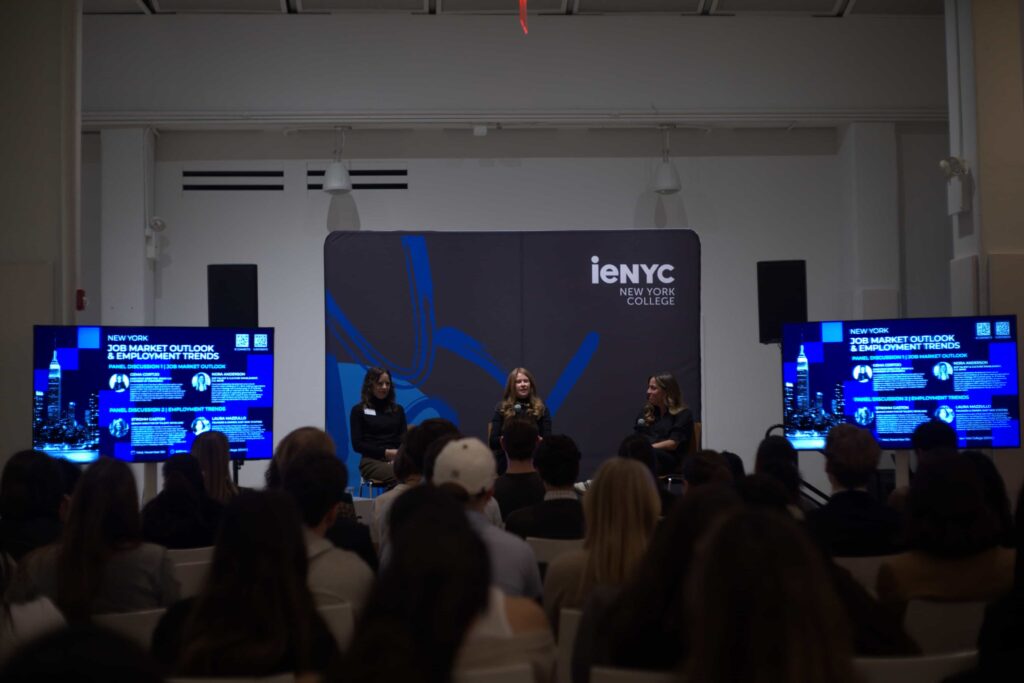
Careers are built over time, through skills that compound, relationships that deepen, and choices that stay flexible. Panels like this transform New York City into an extension of the classroom, where students learn directly from the people shaping the professional world they are about to enter.
As Gema put it, finding your sweet career spot is not about chasing one perfect job. It is about building a foundation strong enough to support many chapters.
At IENYC, that foundation starts early, with access to real conversations, real decision makers, and real guidance on how to build a career that lasts.