


Global supply chains shape the lives of millions every day. Understanding how companies operate, and how their decisions affect workers, is more critical than ever.
That is exactly what Aleksa Pejovic, a student in the Master in Global Business and Sustainability program, explored in his capstone project. His research examined complex supply chain systems, showing how data, law, and strategy can drive meaningful social impact.
We sat down with Aleksa to learn more about the most valuable insights from his work.
I am originally from Montenegro. My international journey began in 2019, when I received a full scholarship to study at Chigwell School in the UK. There, I completed A Levels in Politics, Economics, and English Literature.
This experience deepened my interest in the humanities and social sciences. It also laid a strong foundation for studying Comparative Law at IE University.
My work in the humanities, including being the youngest critic cited in Montenegro’s first Lexicon of Fine Arts and receiving international awards in art criticism, was recognized with IE University’s first full Humanities Scholarship. I am now pursuing an M.S. in Business for Social Impact and Sustainability at IE New York College.
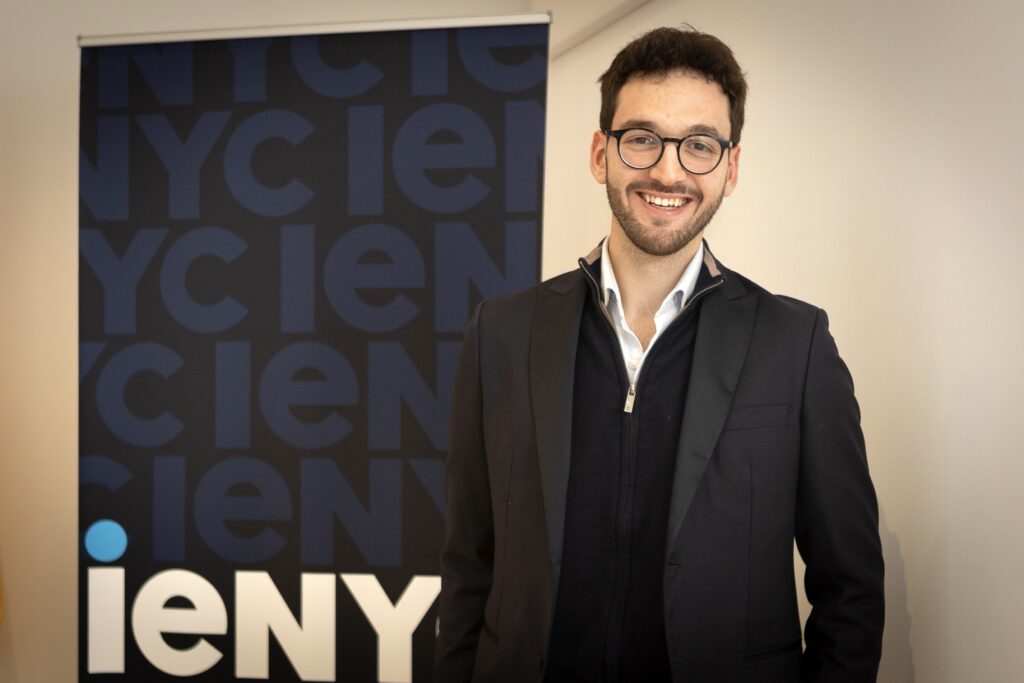
My capstone examined how the structure and governance of global supply chains directly shape workers’ rights and conditions worldwide.
The project aimed to strengthen Avery Dennison Corporation’s human and labor rights due diligence across multiple supply chain tiers. These suppliers operate in more than 50 countries and across diverse industries.
My background in law and experience in the civil sector prepared me to engage deeply with this issue. I was acutely aware of the challenges faced by workers in developing regions.
This project offered a way to create tangible impact: improving working conditions while helping the company meet rising labor and sustainability regulations and position itself as an industry leader.
I began by analyzing Avery Dennison’s annual reports and public disclosures across several years and jurisdictions. This established a clear baseline.
I then conducted a peer benchmarking analysis of roughly a dozen companies across relevant industries and regions. By comparing disclosures, policies, and practices, I identified proven approaches to supply chain due diligence.
The final step was evaluating best-in-class practices and assessing how Avery could realistically adopt them within its operations.
The main outcome was a set of actionable recommendations to improve compliance and risk management.
On a personal level, I gained a deeper understanding of the harsh realities many workers face in developing regions, and how these conditions support consumption in developed markets.
One key insight was the role of the EU as a leading sustainability regulator. Through extraterritorial legislation like the Corporate Sustainability Due Diligence Directive, the EU requires companies to uphold high standards globally. This closely aligns with the concept of global justice I developed at IE Law School.

Courses such as Money as a Force for Social Good and Sustainability Policy and Metrics were essential. They strengthened my ability to analyze corporate disclosures and sustainability reporting.
These skills formed the backbone of a project that was deeply research-driven.

The greatest challenge was managing and synthesizing vast amounts of information. This included hundreds of pages of corporate reports, legislation, and civil society research.
The key was learning how to distill complexity into clear, actionable recommendations. My legal training at IE, with its focus on structured analysis and material issues, was critical.
I was surprised by how many companies go beyond basic compliance. Some recognize that centering supply chain policies around workers – often several tiers removed – can drive long-term value, resilience, and profitability, especially during global disruption.
I hope Avery Dennison adopts the recommendations and implementation roadmap. Ultimately, I want the project to help mitigate labor rights risks and improve working conditions across its global supply chain.
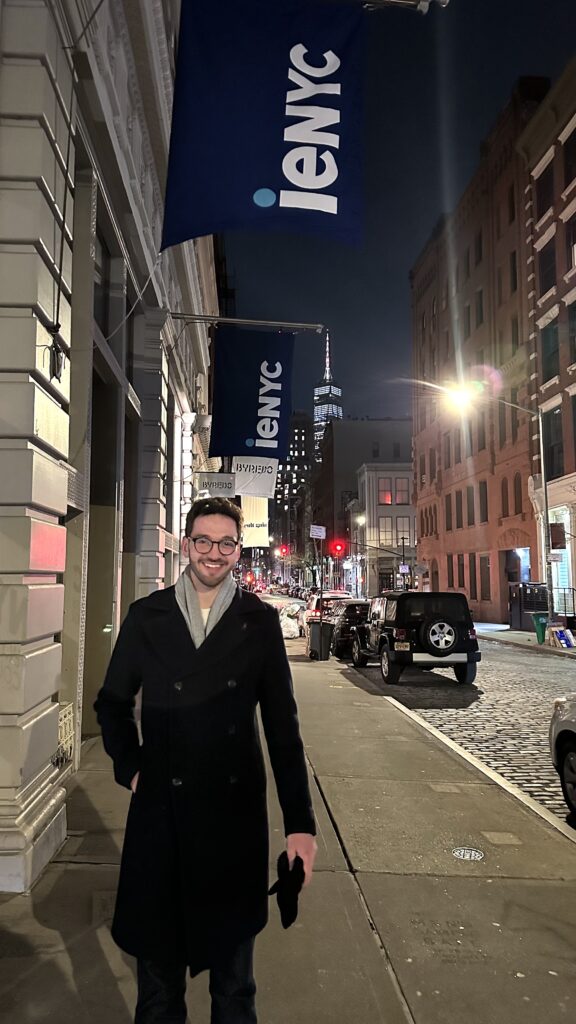
Justice through ecosystems. The experience showed me that large-scale change does not come from isolated intentions. It comes from well-designed legal, regulatory, and corporate systems that embed responsibility across global supply chains.
Aleksa Pejovic’s capstone demonstrates how law, research, and sustainability strategy can deliver actionable solutions for global supply chains. His work shows how knowledge, when applied with purpose, can help build more ethical, resilient, and sustainable business practices.
Discover how IE New York College empowers students to drive social impact and sustainability in business. Learn more here.